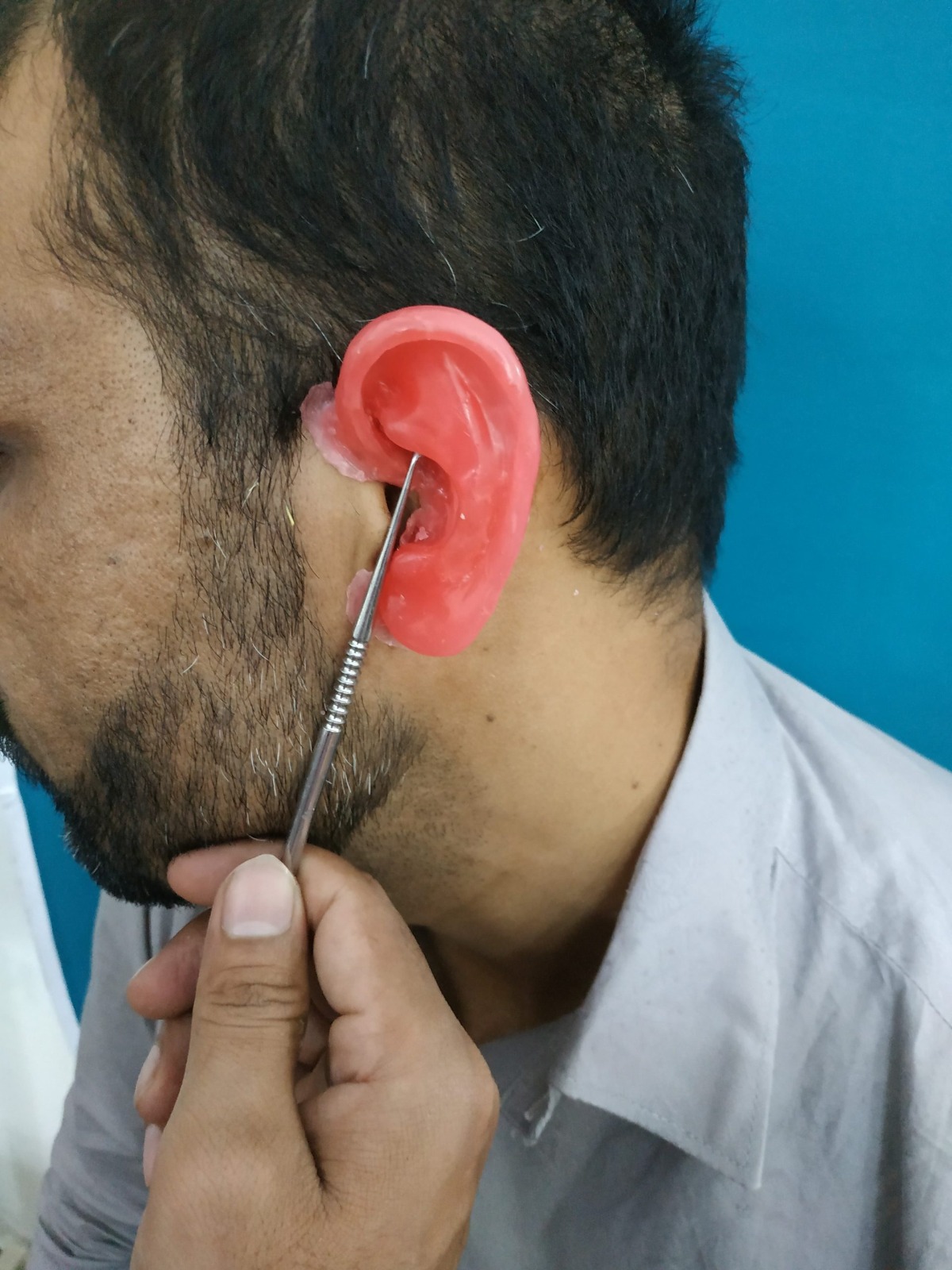
Imagine a sculptor, not working with marble or clay, but human form, painstakingly recreating what has been lost. Such is the nature of anaplastology, and at the heart of what we do at Chughai Anaplastology Centre is an ancient technique perfected with modern skill: wax carving. It is here, in our workshop, that we transform raw materials into life-changing facial and body prostheses.
The Delicate Art of Wax Carving
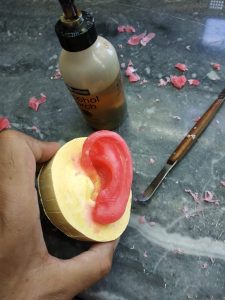
Wax carving prosthetic design is not merely a step in our process; it’s where the craft of anaplastology comes alive. It is a very precise, manual process that requires a level of technical skill and artistic ability. Our skilled anaplastologists employ proprietary dental waxes to manually sculpt a model of the absent or deformed body part. This wax model is the template for the completed prosthesis.
Every detail matters. From the delicate contours of an ear to the sensitive feel of a nose, we sculpt each feature with care to nest into the patient’s existing anatomy and hue. We attend to minutiae as small as creases, wrinkles, pores, and even those organic flaws that give a feature humanity. This close attention to detail guarantees that the ultimate Wax carving prosthetic design is as close to life as possible, integrating perfectly into the patient’s body or face.
Restorations in Real Life
The capability of wax carving is best appreciated in its outcome. This method enables us to craft individual prostheses for a wide range of conditions, restoring not only a physical feature, but an individual’s sense of self and confidence.
For example, a patient who has had an ear lost due to trauma might have a wax ear fabricated, carefully modeling the small helix and antihelix of his or her remaining ear. Or, for a person who has had his or her nose lost to cancer, we can model a nasal prosthesis that perfectly reproduces the exact shape and size of his or her natural nose, for a perfect and unnoticeable fit. Similarly, with a patient losing an orbital space, we are able to create an ocular prosthesis having a sculpted orbital space, which also restores facial balance. The end Wax carving prosthetic design is a testament to the revolutionary capability of this venerable but necessary technique.
Frequently Asked Questions
Q1: How many hours does it take to carve the wax?
The process time for wax carving is lengthy, depending on the complexity of the prosthesis. Simple pieces may be completed in one visit, while complex facial prostheses may require a few visits so that each feature is merely sculpted and checked by the patient.
Q2: Is the wax model an exact final prosthesis?
The wax model is the master plan. It is the end result that we detail out with the patient prior to creating the mold. While the final silicone prosthesis will be an exact copy of the wax model, the silicone will be painted and stippled to look like the patient’s skin and bring the prosthesis to life.
Conclusion
At Chughtai Anaplastology Centre, science and art aren’t concepts—it’s what we practice.
The meticulous craft of Wax carving prosthetic design is a testament to our love of detail and careful nurture. By chiseling out each feature, we don’t simply create a prosthesis; we restore a sense of wholeness and confidence to someone. This old art form, guided by modern skill, allows us to create results that are not only practical but also deeply personal and realistic. We feel privileged to use this practice to regain our patients’ comfort and confront the world with renewed self-confidence.
Ready to see how anaplastology can change your life? Contact the Chughtai Anaplastology Centre today to schedule a consultation. We’ll have the answers you need and take you through the process of a personalized, beautiful restoration. Let us restore your confidence and a feeling of normalcy.